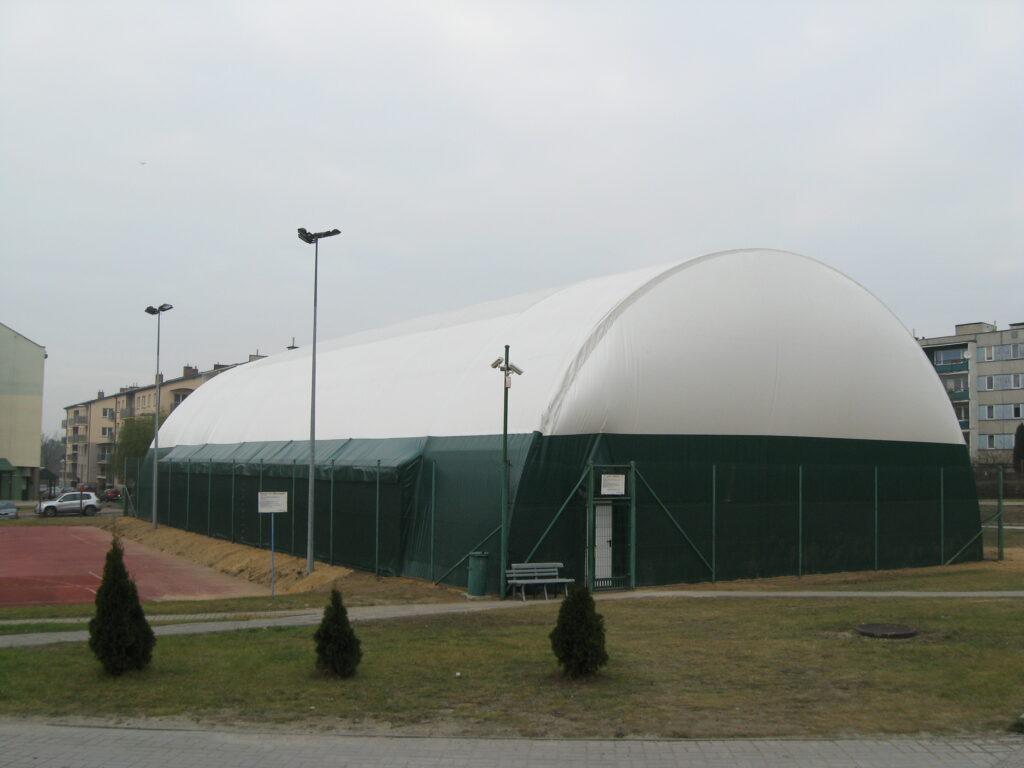
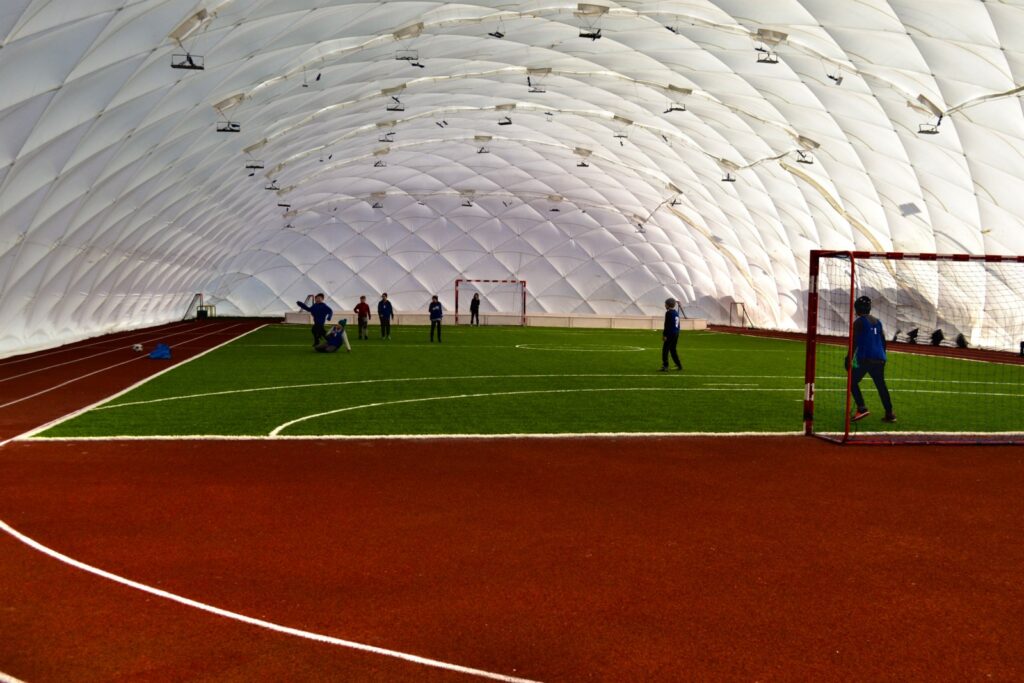
A soccer dome is a sports facility that allows for the use of a soccer field regardless of weather conditions or the season. Due to their size, facilities of this type are typically constructed using pneumatic technology. The structure is based on a specially designed network of steel cables covered with fabric sheathing.
The structure of a pneumatic soccer hall is supported by a low internal vacuum of approximately 2 hectopascals. It is both stable and durable. It easily withstands adverse weather conditions, including snowfall and strong winds.
The soccer arena can also be constructed using a frame structure based on prefabricated steel components.
Soccer Arena – Field Dimensions
Indoor soccer fields generally have the dimensions of recreational and amateur fields, since professional soccer fields built since 2008 are required to be 105 meters long and 68 meters wide.
Due to the previous lack of standardization regarding these dimensions, a range of field sizes approved for sports use had previously been established, which was:
- 90 to 120 meters in length
- 45 to 90 meters wide
As you can see, these are truly large facilities; therefore, for amateur or recreational use, much smaller field dimensions are generally employed, which can easily be accommodated within indoor soccer facilities.
The “My Orlik Field 2012” Program
The “My Orlik Field – 2012” program, which involved the construction of a soccer field in every municipality, resulted in the creation of youth soccer fields with standardized dimensions of 30 meters wide by 62 meters long. An amateur soccer field of this size can be easily covered using steel structures, inflatable structures, or even tent structures.
We also offer a variety of surfaces for soccer fields.
Indoor soccer arena — play regardless of the weather
Soccer is a sport often associated with open spaces, but indoor sports facilities are becoming increasingly popular. It’s no wonder— a covered soccer arena allows games to be played regardless of weather conditions, enhancing comfort for both players and fans.
An Innovative Solution for Sports Facilities
The construction of soccer field canopies is a response to the growing demand for facilities that allow soccer to be played year-round, regardless of weather conditions, while ensuring maximum comfort for the players. The economic aspect is also significant, as a covered field allows for better management of its usage time—not only by soccer teams but also by local communities, schools, and sports clubs.
More and more cities and municipalities are deciding to build such facilities, seeing them as an opportunity to encourage residents to lead healthy lifestyles and improve conditions for participating in sports. It’s not just about providing a roof; above all, it’s a completely new approach to organizing sports spaces.
Construction of Soccer Arenas — Technologies and Solutions Used
The construction of indoor soccer facilities is significantly more advanced than that of traditional outdoor fields. This is primarily due to the need to ensure appropriate playing conditions, both in terms of lighting and temperature. That is why such facilities often feature LED lighting, air conditioning and ventilation systems, as well as specialized flooring designed to help reduce injuries.
One of the key elements of year-round indoor soccer arenas is the roof covering. They are typically constructed using pneumatic technology, which means they are based on a network of steel cables covered with a suitable fabric coating. The pneumatic structure is supported by low internal pressure, which is approximately 2 hectopascals. It is both stable and durable. It easily withstands adverse weather conditions, including snowfall and strong winds.
Depending on individual preferences, the roof can be constructed using a frame system based on prefabricated steel components. By choosing this solution, you can take advantage of the many benefits it offers. Thermal insulation, UV resistance, and soundproofing are just a few of the many features such a structure can offer.
Multifunctional Features — The Advantages of Soccer Arenas
Indoor soccer arenas go beyond the traditional concept of a sports facility. Through the use of modern technologies and creative spatial design, they can serve a wide variety of purposes. Of course, their primary purpose is to host soccer games and tournaments, but that is not their only use.
A well-designed covered facility can also serve as a venue for other events —from concerts and trade shows to various types of community events. This not only increases the visibility and appeal of the venue itself but also generates additional sources of revenue.
Adaptability of Soccer Arenas
Among the main advantages of covered sports fields, their flexibility and adaptability stand out above all—and these qualities increase the more modern the facility is. The use of the latest technological solutions makes it easy to adapt a covered facility to the needs of various sports or cultural events.
Innovative lighting and ventilation systems, specialized sports surfaces, and the ability to configure the space as desired make it possible to quickly adapt the facility to specific needs. This is a huge advantage of indoor soccer facilities, which are becoming recreational venues not only for soccer players but also for a broad range of local residents.
Since 2008, the dimensions of professional sports fields have been standardized to 105 meters in length by 68 meters in width. However, most of the covered fields we are familiar with are sized only for amateur and recreational use.
From the perspective of sports clubs, the ability to adapt a facility directly translates into financial appeal. A space that is weather-independent and, at the same time, tailored to a variety of needs is a venue with enormous commercial potential.
The Soccer Arena and the Environment
Growing public awareness of environmental issues is also having an impact on the sports industry, including sports facility construction. Many investors and sports facility managers are paying increasing attention to aspects related to sustainable construction.
In the case of the construction of soccer arenas , this means, above all, energy efficiency—such as the use of LED lighting, solar panels, and heat recovery systems—and these are just some of the solutions that significantly reduce energy consumption. Lower CO2 emissions and standardized recycling and waste management processes are becoming increasingly common in modern sports architecture.
Sustainable construction offers numerous benefits not only for the environment but also for the users themselves. Health-friendly materials, good air quality, and thermal comfort are factors that contribute to the quality of training sessions and the well-being of athletes.
The Future of Soccer Arenas
The future of these modern sports facilities looks extremely promising. On the one hand, we have technological advances that open up entirely new possibilities for designers and users. Increasinglyadvanced systems make it possible to create facilities that are as flexible, energy-efficient, and comfortable for usersas possible.
On the other hand, the growing importance of sports in society means that soccer arenas are becoming key landmarks in every city. They are increasingly being used as community spaces, including places for socializing and recreation. This is a trend that will certainly become even more widespread in the future.
A multifunctional, modern, and adaptable indoor soccer facility is a concept that is gaining increasing popularity among sports clubs around the world. It not only allows for professional training sessions regardless of weather conditions but also serves as a venue that brings the local community together. It is an investment that can pay for itself many times over, often generating additional financial returns. Extensive flexibility, eco-friendly solutions, and growth potential are the factors that are attracting more and more people and organizations to these facilities.