Thanks to the successes of our female tennis players, such as Agnieszka Radwańska and, more recently, Iga Świątek, tennis is becoming increasingly popular, and with that, the demand for tennis courts is growing. Depending on the surface used, tennis courts have specific playing characteristics. When choosing a specific tennis surface, we are therefore also deciding what kind of tennis will be possible on it, since the surface affects the flow of the game. The game can be fast, medium, or slow. So, what should you choose?
Tennis Surfaces: Types of Tennis Courts
The types of tennis court surfaces are a key element of the game that define aspects such as ball speed and bounce —whether the ball bounces higher or lower—the style of play, and thus the level of protection for the knees and ankles, as well as many other factors. Therefore, what matters most here isn’t primarily their price, but the style of tennis we want to play. Tennis courts can have several types of surfaces, and each has its own specific characteristics, so before we begin building courts, it’s worth familiarizing ourselves with the exact specifics of their surfaces.
Clay courts – dirt courts
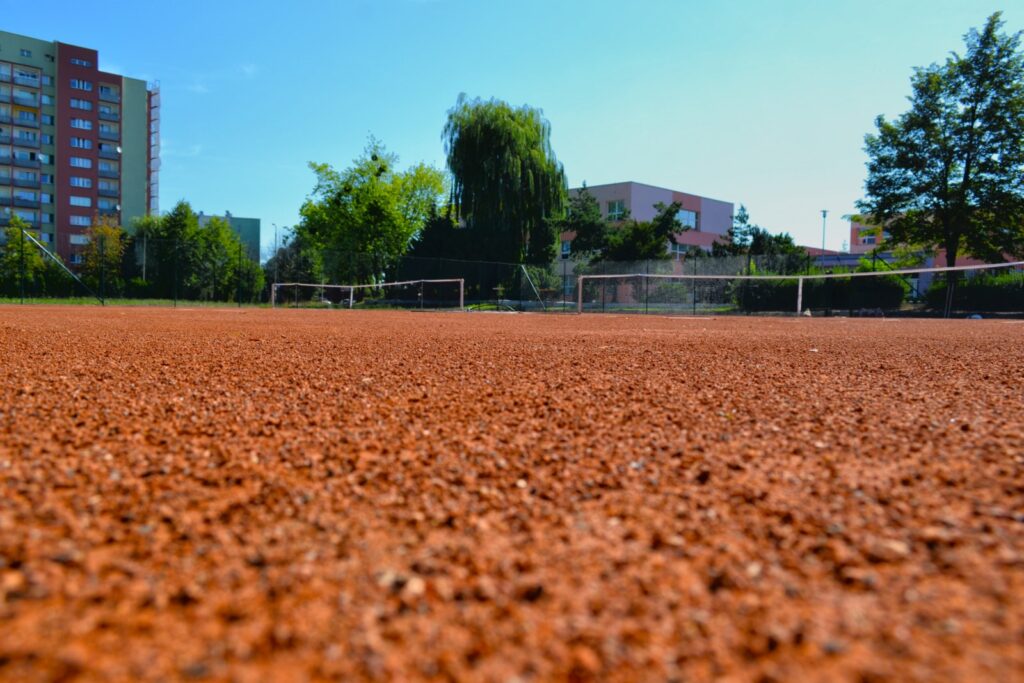
 Clay courts, also known as earth courts or brick courts, remain among the most common types of tennis courts. They are characterized by a rough surface, which causes the ball to experience high friction; therefore, these courts are slower—and in some cases, the slowest. This is because clay is a soft surface that slows the ball down, meaning the pace of play is slower than on hard courts. This allows for a style of play featuring deep shots and long racket swings. It also makes sliding possible.
These courts are also characterized by a higher ball bounce, which makes the game more predictable than on hard courts. For this reason, on clay courts, players often employ a defensive style of play and engage in long rallies to tire out their opponent and find a favorable position to attack.
Grass tennis courts
Grass is a natural surface, which means it is softer and has less friction, causing the ball to move faster across the court. This results in a very low ball bounce on a grass court, meaning the ball usually stays low after being hit, and the pace of play is fast.
For this reason, on grass courts, players often have to adopt an offensive style of play, using frequent volleys hit from a high position. Furthermore, playing on this type of court requires a tennis player to have strong technical skills, good speed and reflexes, as well as the ability to play offensively and adapt to the specific conditions of this surface.
Acrylic courts
Acrylic hard courts are an interesting alternative that is slowly catching up in popularity to brick dust courts. These courts are made of synthetic material covered with a thin layer of acrylic. Their base is usually a concrete or asphalt foundation. These courts are not very flexible, but they allow for a faster game—they are faster than clay courts.
Courts covered with artificial grass or carpet
The third most popular tennis surfaces, which allow for the fastest play, are:
- synthetic grass
- carpet
Matches played on these types of surfaces are fast-paced and require an aggressive playing style, with short rallies (quick ball returns), and moving around the court demands decisiveness and frequent play at the net.
Which tennis surfaces are best for outdoor courts, and which for indoor courts?
Artificial grass and clay surfaces work best on outdoor courts. This is because they have high water permeability, making them ready for play again quickly. Acrylic surfaces can also be used outdoors.
Carpet surfaces, on the other hand, are intended for indoor courts, but after applying impregnation, they can also be used on outdoor courts.
With proper care, all types of tennis surfaces can be used on outdoor courts . However, it’s worth understanding the operating costs of each type, as they vary significantly.
Famous tennis tournaments—what are the court surfaces?
The biggest tennis tournaments, known as Grand Slam tournaments, are held all over the world—including Europe, Latin America, North America, Asia, and Australia. Importantly, they are played on both hard and soft surfaces, which adds variety to the game and allows players to test their skills on different courts. And so:
- Hard courts —the most commonly used surface in the world, featured in most tournaments. As mentioned earlier, this surface is made of concrete or asphalt, with a layer of synthetic material on top. Examples of tournaments played on hard courts include the Australian Open, the U.S. Open, and many other tournaments in the United States.
- Clay – this surface is softer than a hard court and consists of brick ground into a powder, held in place by a binder such as clay. It is a surface commonly used in Europe, including at Grand Slam tournaments such as the French Open.
- Grass —a natural surface that requires special maintenance and is used primarily on courts in the United Kingdom. Grass courts are characterized by a fast pace of play and a low ball bounce. Wimbledon is a tournament played on grass.
- Artificial courts are surfaces made of various materials, such as rubber mats, synthetic carpeting, or tartan. They are used at some smaller tennis tournaments and at the Olympic Games.
You can find more information about our offerings on our Grimar website.